

Some people track steps.
Some track sleep.
I track the vibes of the air in our home.
This project started innocently enough: I wanted to understand how temperature and humidity varied across the space and how well (or poorly) the HVAC system was doing its job. Naturally, this escalated.
Phase 1: Temperature, Humidity and HVAC
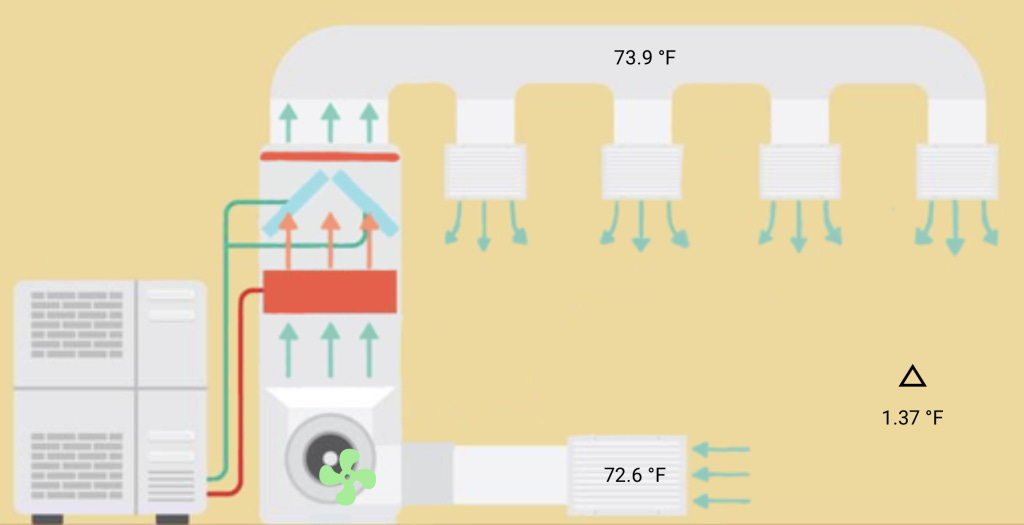
I began with Zigbee temperature and humidity sensors placed all over the place:
One in each room
One on the balcony for outdoor reference
One at the HVAC return
One directly on a supply vent
All of this feeds neatly into Home Assistant, where I built a dashboard to visualize room-by-room temperatures and the HVAC delta between supply and return (inspired by my experience with commercial building automation systems).
This alone was enlightening:
Rooms don’t heat or cool evenly (shocking, I know).
The HVAC delta tells me all about system performance.
I checked this dashboard constantly… at least until the novelty wore off and it became “background knowledge.”
Obsessive? Absolutely.
Sustainable obsession? Apparently not.
Phase 2: Enter the AirGradient (aka: The Point of No Return)
Just when I thought I was done, I added an AirGradient indoor air quality sensor.
And wow. That escalated quickly.
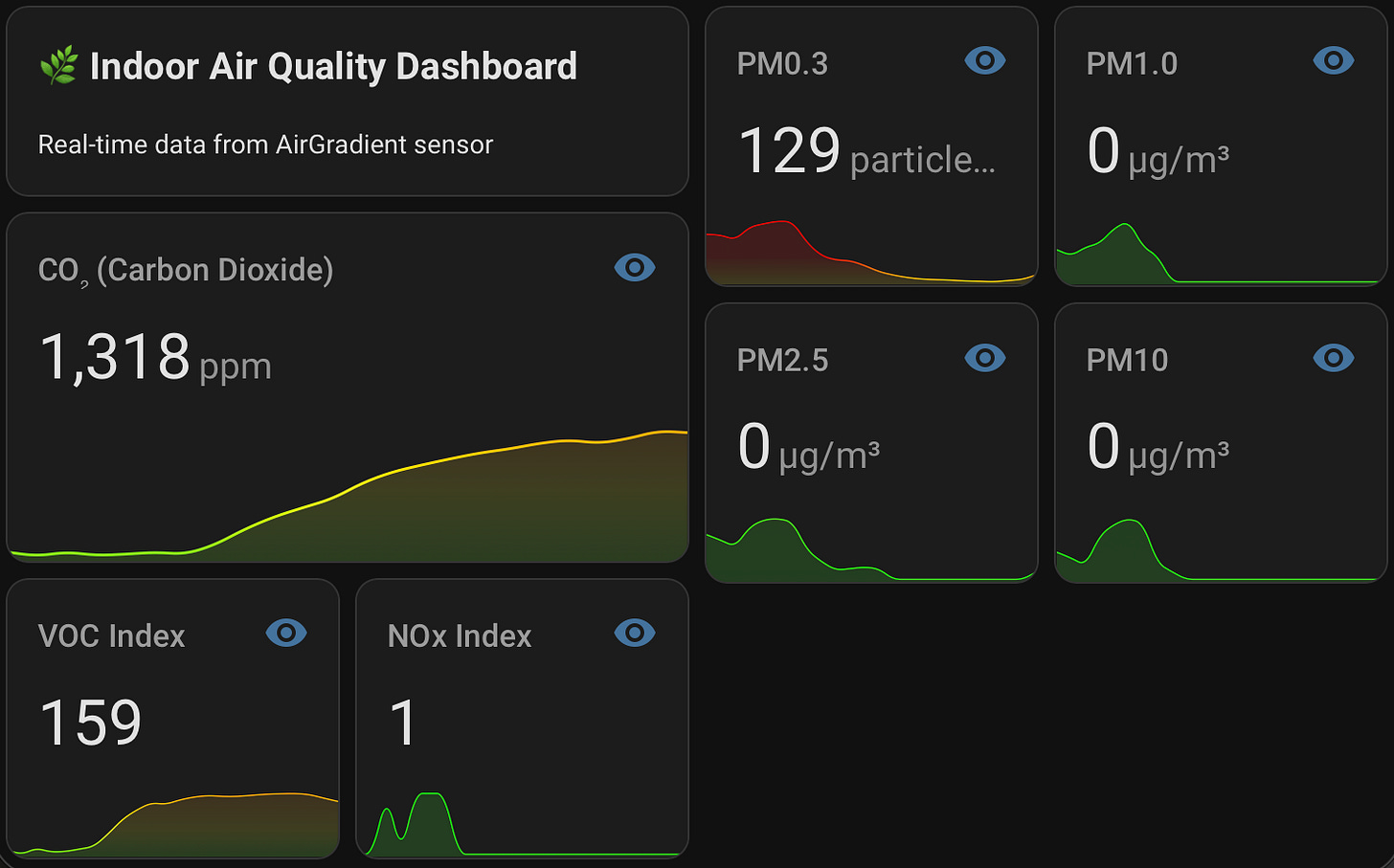
Now I’m tracking:
CO₂
PM0.3, PM1.0, PM2.5, PM10
VOC Index
NOx Index
What the Data Taught Me (Besides Humility)
The biggest takeaway? Indoor air circulation is… not great.
CO₂ levels rise faster than you’d expect, especially with doors and windows closed. Elevated CO₂ is known to impact cognitive performance, and seeing it climb in real time is a powerful reminder that sometimes the smartest automation would be… opening a window.
Honestly, I think everyone should have a CO₂ monitor. Not to induce panic… but to gently say:
“Hey, maybe let the outside in for a minute.”
The particulate and gas sensors were equally revealing:
Cooking spikes PM levels fast (especially frying).
Laundry and mopping have a noticeable VOC impact.
Candles are tiny pollution machines.
Leaving the door open while the Turkish restaurant nearby is cooking onions? Immediate confirmation. No notes needed.
Mitigation
We do have a standalone air purifier, and it absolutely works. You can see particulates drop in near real time once it detects the pollutants and the fan turns up. That said, the data made me think about how many people don’t have these things..
Air quality monitoring
Active purification
Or even awareness that indoor air quality can vary this much
You can’t fix what you can’t see. But I guess seeing everything is not always great either.
Final Thoughts
Is this setup overkill?
Yes.
Do I regret it?
Not at all.
The combination of distributed temperature sensors and the AirGradient has turned my home into a living, breathing dataset. One that gently nudges better habits, including a subtle AWTRIX notification when CO₂ levels get too high.
And if nothing else, it’s deeply satisfying to say:
“These onions aren’t just strong… they’re measurable.”